

Retired architect Tay Kheng Soon is 85 years old this year. In his long and illustrious life, he has seen much, from his childhood days in Malaysia to the rapid growth in Singapore.
Here are his precious memories, curated from his Facebook posts.
The First Memory:

Little memory 1: In the 50s we ran about the neighbour-hood bare foot. We developed thick callouses which cracked so we used a razor blade to cut those parts away on the soles of our feet..
Second Memory:

Little memory 2:
These electric trams were also called trolleybuses. They ran of electricity from overhead cables on main roads in the Singapore city and beyond.
As we peer out of our Serangoon Road row house upstairs window we see the electric trams pass by. We hear the switch sound as the rollers spark across the cable connectors. Then there is the sound of chinese recitation from the school opposite. This is interrupted by the tiktok, tiktok of the mee seller downstairs, the bells of the Indian temple to the left can be heard. This is 1946 Singapore…
Third Memory:
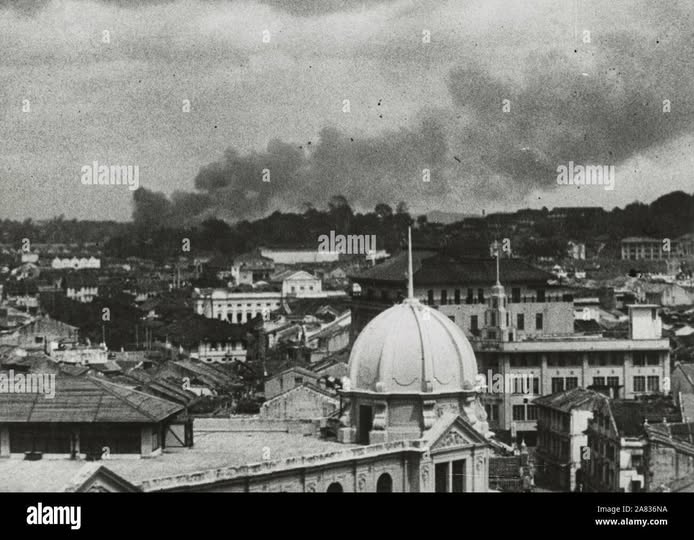
December 8th 1941; my first birthday, the Japanese bombed Singapore. This is my first memory. I recall the whine of the bombs as they fell then the distant thud of the explosion. I also membered the smell of the gunny sand bags that surrounded our shelter under the concrete staircase. This i confirmed with my mother years later. She also confirmed my memory of the clacking sound of milk being made in an enamel mug.

Little memories 4: in 1947 in ACS Primary School in Coleman Street there was a rubber tree growing on the hill slope at the upper level open ground next to the canteen shed. That’s where we played. One favorite prank was to rub a rubber seed on our trousers. This made the seeds very hot to the touch. Unsuspecting classmates would be shocked in sneak attacks to loud laughter. This led to amusing rubber seed wars… why don’t we grow rubber trees nowadays?
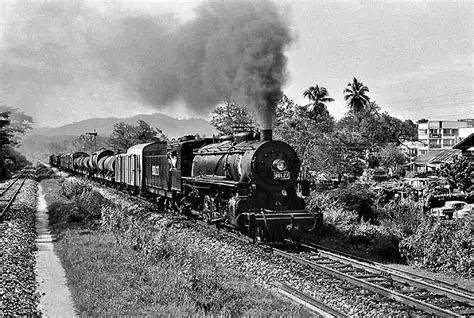
Little memories 5:
I was probably 2.5 years old on a Malayan Railway Train, MRT, to Tapah enroute to Ringlet, Cameron Highlands.
I can still see in my mind’s eye the scene in the carriage where we were. It was hot, with a strong smell of Indian curry and sweat.
My whole family was huddled on the floor, leaned against the backwall of the carriage behind the last bench, a space of 1m square
There were many small skinny Indian labourers in the carriage, some lying under the seats. My most vivid memory is one lying, wedged in the overhead baggage shelf if the carriage.
Another memory is the beige colour of the large square floor tiles with wedge sides of the toilet. Years later as an adult, I made it a point to check out that memory.. yes indeed I remembered right but the square are not large as in my memory. They are indeed beige in colour but little wedge shaped square floor tiles. I then realised that as a small child my eyes was much closer to the ground. This explains the size perception…

Little memories 6: Smell of the Earth… in 1947, our house like in this picture had a bare, and parched ground next to it. A hole about 600mm cube was dug to plant a rambutan tree. I saw it as an opportunity to turn it into an underground house so I found a wooden soapbox as roof. Then rain came. I peeked out through the cracks, saw big rain drops hit the ground and heard it drum on my ‘roof’ top but it was the pungent earth smell that struck me. It was a sharp, almost chemical like scent, something i had never experiened till then. That was my early experience of living space and nature…
This is not my house. It is only to illustrate the kind of hot dry land next to the house
Little memories 7: 1948, turning a shed into a home… i found wooden battens and asbestos sheets left by contractors with which I built a little shed on top of a concrete manhole. The concrete was one meter by three quarter with the small rectangular metal cover in the centre. I planted pairs of the battens into the ground just outside of the concrete slab. I slotted the asbestos sheets in slot between the battens. These formed the three sides of the ‘house’ i was building. I left a ‘window’ on the front, put the roof on and crouched into the space. Yes, it felt like a shed but rather bare. I thought I would make a window cill and without thinking a lot put a flower there and suddenly! My little shed felt very different! It felt like a home! That was another early lesson on architecture. I was seven and the half years old…

Little memories 8: Magnolia Champaca… i remember in the 70s when me and my brother’s families would gather under the shade of the Champaca tree at the front of our parent’s house in Braddell Heights.during Sundays. The mix of fun and fragance remain in my memory. Champaca flowers are small, they can be strung into garlands. You can find them in little India flower stalls. In the West champaca are called Magnolia Champac. The flowers there are much larger. We should plant lots of champaka…The leaves are about 150mm they are easy to sweep up

Little memories 9: Casurina Equisetifolia… my father in 1948 planted two behind the house one for my brother and one for me. They grew very fast. By 1954 I could climb them. From the top I could see distant landscapes. Now I realize what I saw westwards is Toa Payoh. I imagined wonderful places to explore. That is when I said to myself that I must walk every inch of Singapore and that is what I did.
I remember the hills and valleys of Bukit Batok, walking past the clay pits of the brick making factories, the sand hill of Bedok now flattened to create East Coast Park. I remember crossing golden sunsets over Kranji River in a Sampan. With my Scout group led by scout master was terrified by thunder and lightning, drenched to the bone as we reached Tuas Point to shelter in its hilltop pillbox. Camped in seaside Pasir Ris coconut plantation withing distant sight of the beach hotel. Wandered along the kampong trails from Bedok to Mata Ikan and Ayer Gemuroh seeing the kilns turning sea shells into lime wash tubs. Climbed Bukit Timah hill by scrambling up along little streams and tiny waterfalls feeding into small clear water pools. Was surprised to see prawns in them and wondered how they got up the mountain… exploration took on many forms but the one fascination is the reward from curiosity…
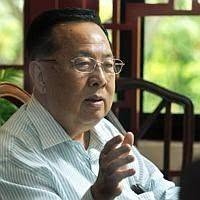
Little Memory 10: Ngiam Tong Dow
Roti Kaya and teh-oh breakfast with Ngiam Tong Dow. We used to meet occasionally at Rail Mall coffeeshop. After he retired he in 1999, he gathered together a group of his old colleagues. Sometimes I was included. He told them that now I was his friend but when he was in service, he regarded me as enemy. Aiya, that’s the way it is… he was very candid with his thoughts. He said the biggest mistake of LKY is to pay ministers and those below them super high salaries. Of course I agree with him.

Little memories 11: Soup Kambing… I avoided mutton in my youth because I was told that mutton would make one mad. Of course as a child I believed it. One day while wandering near Capitol Cinema. There was a carport next to the cinema. On the opposite side was the British army and navy club. At the rear if the carport was a small tuck-shop. The friend with me suggested we eat there and he said the soup lambing there was super. Defying all my instincts I decided to try. Wow, the soup was thick and spicy and the mutton tendons soft. Tucked at the bone to get at the insides, dipped the crunchy French bread roll chunks in the soup. Haha did not feel deranged! That ended the childhood spook!
Little memories 13: 1945, returning to the family home at 558A Serangoon Road from Cameron Highlands by lorry at the end of the Japanese war.
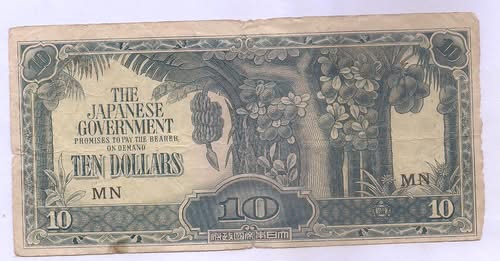
I was 4 years old. It was night. I remember the dimness and the dustyness. The lorry parked in the middle of the road. We got down. My parents opened the front door of the flat. I remember climbing the dusty staircase up to the flat above. I remember the shelves lining the landing. My father did a roaring business making and selling “Johnson’s baby water”. He hid British Straits Dollars in the flat. The “banana notes” issued by the Japanese was useless
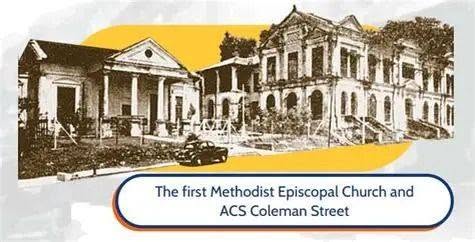
Little memories 15: 1947, ACS primary school at Coleman Street.
I remember Miss Smith, a stern teacher and a Miss Russel, a warm and kind lady. They taught us english grammar and prounciation.Then there was the chapel where there was morning service. Written in big Roman letters were the words, ” TRUST IN THE LORD WITH ALL THINE HEART AND LEAN NOT UNTO THINE OWN UNDERSTANDING. IN ALL THY.WAYS ACKNOWLEDGE HIM AND HE SHALL DIRECT YOUR PATHS.”
These words went round the top of the four walls of the chapel left a strong visual impression on me even though at age 6 I did not understand their meaning.
I remember the first day in school. We were lined up according to height. The tallest ones went to A class, then B, then C according to diminishing stature. Mothers clustered at windows as we were marched into our respective classes.
A boy in front of me sent a stream of piss in his fear. At recess time we went to the tuck-shop higher up for a snack.
By primary 2, we began exploring around the school. Lots of trees arched across Fort Canning Road. I remember those black and white singing birds. Later i got to know they were magpie-robins.

We noticed the entrance gate arch of the Fort Canning Cemetery in the distance. There was Sands House, across the road to the right. on a slight rise. It was a little dilapidated, we thought it was haunted. Below it were several basket ball courts belonging to Tao Nan School. Across the road was the Armenian Church surrounded by lawns and trees…there was a large mysterious building on the left next to the fire station.

Little memories 16:
1950s, inspired by Thor Heyerdahl’s Kontiki expedition by balsa raft from Peru to cross the Pacific Icean, 4 of us ACS kids built a raft using 4 rubber tyre inner tubes and set out to sea from Tuas. It was the December holidays and the northeast monsoon wind was blowing off shore. We were heading very fast towards Indonesia. We tried to row back but it was impossible. I put on my flippers and got overboard to try to push the raft back to no avail. A marine police boat spotted us and towed is back to shore. Phew! That was the end of the Kontiki dream
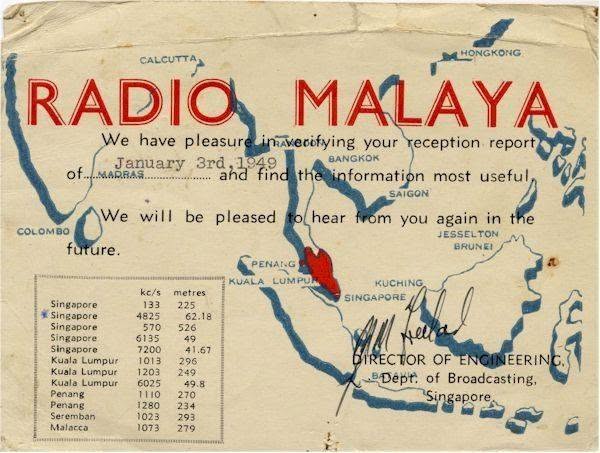
Little memories 17:
Radio Malaya in the 1950s broadcast several intriguing stories that remained in my memory. Me and my brother huddled around the family radio consistency to hear stories of ancient Khmer expeditions to Tasek Bera in Pahang and left clues in the Asli languages there.
Then there were sound recordings of of Temiah and Semai chants and bamboo music. These enthralled us. It woke up the music in me! Malaya was not just a territory. It conjured imagination of a people, place and sweep of time. My identity is made up of these memories…Thank you Radio Malaya!

Little memories 18:
Ayn Rand’s book Fountain Head had a profound effect on adolescent me.
Yes, of course the book was a take on the life of architect Frank Lloyd Wright.
The book was the main topic we young architecture students as we drank coffee at the sarabat stall sitting under the trees opposite the Polytechnic at Prince Edward Road.
It was the fighting spirit of Howard Roack in the book that was inspiring.
Ayn Rand’s ultra right wing politics was obscured for us by the heroics of the character in the book. My politics was more shaped by Bertrand Russell.
It was only much later that i connected Ayn Rand’s politics with The Neoliberalism of Milton Friedman and his connection to Lee Kuan Yew’s shift from socialism towards capitalism

Little memories 19: Atlas Shrugged by Ayn Rand boosted my young ego but also warned me of corporate malice. It was a political awakening to the problem of elitism and bureaucratic tyranny…BTW, Ayn Rand is required reading in the Republican Party of USA.
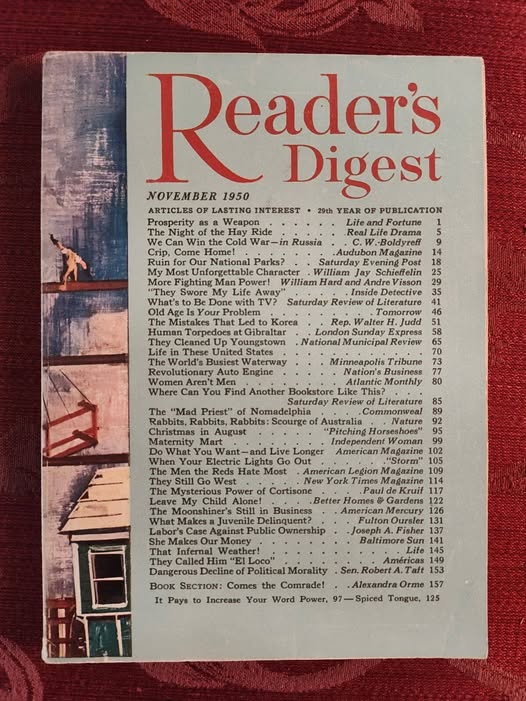
Little memories 20: ACS in 1956. We had Mr. Lee Hah Ing as our class master. He did an incredible thing. He turned the last two friday periods into the “literary club” in which we could present and discuss anything we had read the previous week beyond our school books. I was elected literary club chairman. This gave me the opportunity to share the many things I came across in Readers’ Digest which came every month. My father had subscribed to National Geographic and the Readers’ Digest. These, me and my brother devoured avidly.
Little memories 21: 1955, National Geographic was another powerful inspiration. I read a fascination article on a kayak expedition all the way down the Nile river. I decided to build my own kayak from the battens my father was using to build his orchid shed. I built the frame at the back if the house using the drain as the formwork. I worked through the night and completed the frame by morning. The next day i stretched discarded kaki fabric from my friend Kho Kwang Poh’s family shop and waterproofed it with layers of oil paint. Brought to kayak to test in a nearby pond. It worked! Years later my son rowed a kayak from Changi to Tioman. It’s in the blood…
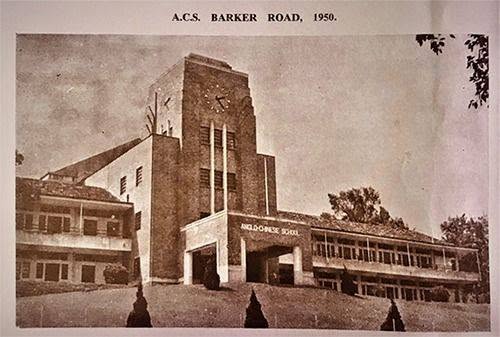
Little memories 22: ACS Barker Road in the 50s was a very fun place. Yes we studied hard but we played hard too. One time, we climbed into the clock tower to see how the mechanism works. We were surprised that there was a small motor in the center with four radiating arms radiating from it to drive the long and short arms of the clock face. Another time I climbed up to bend the hammer if the school bells as an April fools’ prank. There was a steep grassy slope down to the sports field from the pastor’s house above. We used the palm fronds as a sled to slide down at great speed. As scouts we went to Sungei Road Thieves Market to buy ex-military daggers which we wore as part of our uniform. The scout den was an upstairs place in the old, Oldham Hall building behind the new building. This was our hangout place. The floor planks were excellent for us to throw our daggers to stick despite the disapproving gaze of Lord Baden Powell’s picture hanging on the wall.
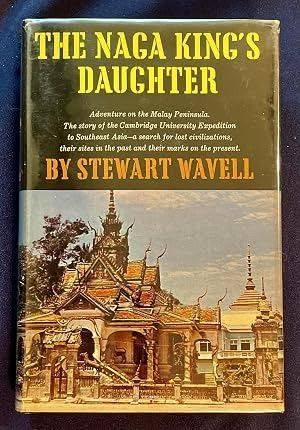
Little memories 23: Stewart Wavell’s stories broadcast on Radio Malaya in the 50’s opened my mind to the romance of ancient Malaya, on Tasek Bera, of Temiar bamboo, rhythmic music, of Lankasuka and Tambralinga.

Little memories 24: in 1954, my father finally bought us each a Hercules Bicycle. Mother made us promise not to ride on main roads. But a bike was freedom! And soon I was riding all over Singapore. Of course I rode to school and after sports, I rode back. I remember three bike bank-widths of riders along Serangoon Road stretching way ahead and me trying to overtake them. I just had to, to prove to myself my capability at age15.

Little Memories 25: 1950’s inspired by Han Hass’s diving adventures in the Caribbean and the Red Sea, we bought Diving Masks and Fins from “Kings”, a sports store at Raffles Place. The first diving spot was Sisters Island reached by bumboat from Collyer Quay. Johore Causeway was another place especially during the NW monsoon when the tide is higher on the eastern side and the water gets filtered as it is pushed through the causeway. So we get a bulb of very clear water on the Western side where we could see to the seabed 20 meters below. There were lots of grouper and we speared many. The next 10 years led us up the Malay peninsular to the great islands on the east coast.

Little memories 26: 1957, I met Mr Ng Keng Siang, FRIBA, Singapore’s top local architect to seek his advise. Should I become an architect? He sat behind his desk in Asia Insurance Building and looked me in the eye and shook his head… he said the profession was a dog eat dog business. DON’T! I was undeterred, I felt Architecture in my bones but where to study was the problem.
Fate had other plans. My brother was Singapore’s top student in both O and A levels and was due for the Queen’s Scholarship but that was a transition moment to change to State Scholarship. PAP had just taken power in 1959. My father believed that his insurance rival Mr Yong Nyuk Lin, then also Minister of Education may have deliberately fumbled with the transition so my brother had to forgo the Scholarship or lose his place in Bristol University in UK and be financed by my father.
So, no money to send me abroad. So I enrolled in a correspondence Architecture course and apprenticed with architect Ang Kheng Leng at $50 per month! I did not mind, I enjoyed tremendously working there and soon took on many design jobs even as a junior!
The Singapore Polytechnic announced the Architecture course soon after and I rushed to apply with my portfolio of drawings and was immediately enrolled and the rest is history…

Little memories 27: Singapore was declared by the British monarch King George VI a City because it reached a population of one million in 1951.
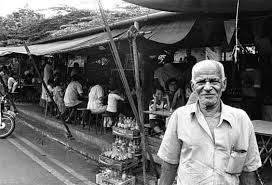
Little memories 28: 1950s, Indian Rojak at Waterloo Street next to SJI sports field now built over by SMU. The Super best! Unique sauce. Best Indian rojak in the world..
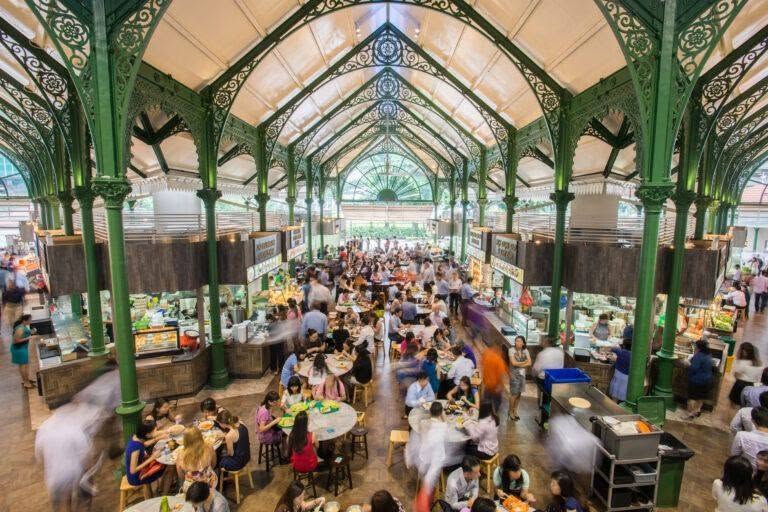
Little memories 29: Lao Pa Sat in the 1950s and 60s had the best hainanese mutton soup in the world! Long queues! Goat brain was a speciality!

Little memories 30: 1965, in a large shed on the bank of the Jurong River my 40ft sailing catamaran was being built by my friend Edmund Koh who was a floor tile sales agent turned boat builder.
Bunga Laut, flower of the sea, was the name I gave my $7,000 boat. Edmund built the catamaran based on the plans by James Warram a polynesian sailing craft enthusiast. As soon as Bunga Laut was launched and with book in hand reading, “Teach yourself Sailing”, we sailed to Pulau Tioman in the South China sea!
On the way we were struck by two huge squals. The first spun us around. The second was out of sight of land. Disoriented, I remember having read, “A pattern of Islands” by Arthur Grimble and remembered a part in his book that the clouds over a reef would be green reflecting the reef. That is when I saw it and that was the way to Tioman!
Sailing somehow linked me back to my Austronesian-South China roots. That began my quest into another dimension of my Malayan identity, the migration from Taiwan south to Philippines then eastwards to polynesia and westwards to Madagascar.

Little memories 31: 1965, another Bunga Laut sailing memory. We sailed up the East coast of Malaysia towards Pulau Tinggi, that wonderful symmetrical volcano silhouette in the horizon. Anchored next to one of its little sister islands. It was late morning and we were preparing to have lunch. Suddenly a marine police came by and boarded us demanding to see our passports. We did not bring any. We were terrified. We had entered Malaysian waters illegally… my friend Tony Tan was cooking down in the galley and strong smell of blachan wafted up.
The police officer’s demeanour suddenly changed. “Ah, you making blachan yah, bagus!” With that, the whole atmosphere relaxed and the officers sat down and chatted with us and soon left! Phew! This was an eye opener! Shared culture over rode legality on the open seas!

Little memories 32: another sailing memory at Pulau Tinggi. I climbed up the steep hill slope and came across a man seated on a platform outside his hut staring out to sea. He was friendly. I asked him what he was doing so high up away from his boat on the beach below. He replied, ” Saya suka, sini chantek.” I like, it is beautiful up here. It was such a revelation to me. This is deep malay culture. Yes, fishing is making a living but beauty and serenity is life! Why can’t we have both?

Little memories 33: 1960, my first motorbike a Lambretta. I chose it because it’s engine was centered unlike the Vespa which was asymetrical. I rode to Poly every day. Soon, several of my classmates also bought Lambrettas and we explored all over Singapore and Johor. In those days every Lam rider waved to each other as we passed.. It was a brotherhood. The attached picture was taken in India where Lambrettas are now built.

Little memories 34: 1980, I remember this year precisely because I needed specs and dropped out of my flying lessons at Singapore Flying Club. I just wanted to experience flying. That’s when I realized the bikini airspace we have we also had to fly at 500ft. No fun… my brother and I built a bamboo hang glider in the garden in 1952. Luckily it could not fly. It had no harness. It’s wing surface was paper which tore. We built lots of model aeroplanes from kits. My “vortex” glider was tested at the St Andrew’s school field. There was no radio control so we did only short flights fearful we will lose the plane. It must be in the genes because my son soon became expert in radio controlled gliders.

Little memories 35: since my Lambretta days i have been riding bikes of all kinds. My present one is a 3 wheeler. I love biking, the 3d space, the wind, the freedom…

Little memories 36: 1959 first year architecture studio. We had to build our own drawing boards and tee squares in the Poly workshop. That was the beginning of our education, the link between making and thinking. Between construction and design aesthetics. Next, we built an incinerator brick by brick. I learned welding to make a steel sculpture out of steel rods. Next we went to Malacca to study mslay houses by measuring, photographing them and drawing document them. Meanwhile we studied the life of artist Gauguin’s life in tahiti. Many of us read Ayn Rand’s book, “The Fountainhead”, a take on the life and struggles of a factionalism Frank Lloyd Wright. I challenged traditionalism by desiging a modern kampong house with a flat roof. Practicality combined with intellectuality was for me the foundation of my design thinking.

Little memories 37: 1963, my final year design thesis of a fine arts faculty at Bukit Timah Campus with facilities for exhibitions, art and sculpture museums, studios, and performing arts facilities.
I felt even then that campus life is incomplete without the fine arts. Here is Dr Toh Chin Chye looking on bemused. On my right is Mr KC Chung one of our tutors.
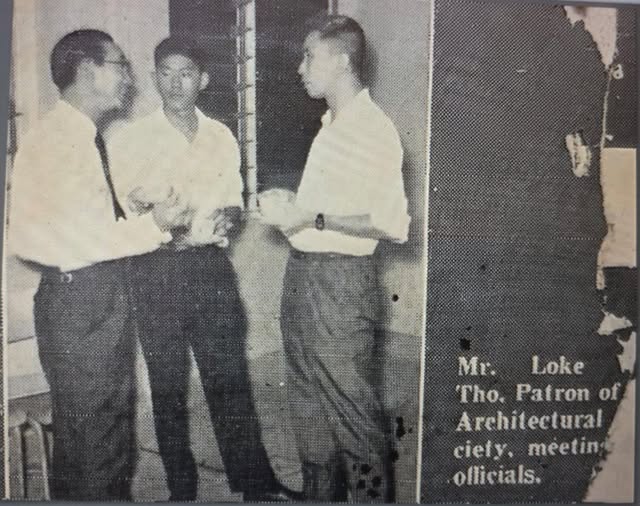
Little memories 38: 1961. Me as chairman of SPAS, Singapore Polytechnic Architecture Society, greeted Mr Loke Wan Tho, president of Cathay Organisation as our Patron. We had the nerve to write to him requesting him to be our patron and he actually agreed to pur surprise.
Here i am in this picture with our teacher Lim Chong Keat. The occasion was the first international architecture students’ exhibition. We wanted to see where we stood against others because we had no idea how good or bad we were. We came away feeling we were ok.
Another thing happened: during the opening ceremony everyone was surprised when the OCBC Chairman Mr. Lee Kong Chian walked in uninvited! Loke Wan Tho warmly welcomed him and we students felt truly honoured. Such were those days..

Little memories 40: 1950, the 10 volumes of Arthur Mee’s Children’s Encyclopedia was a great source of ideas to while away the long days. It was our way, in Bertrand Russell’s essay to live, “In Praise of Idleness” the Encyclopedia, Reader’s Digest and National Geographic overtook, Enid Blyton’s stories and the adventures of Gimlet and Biggles… idleness was indeed a virtue

Little memories 41: this memory is painful. The rebuilding of my old school at ACS Barker Road was painful. The appointed architect’s design failed in so many ways. The worse was the need to demolish the clock tower and build a replica on a different location because the new overall layout required it. To justify rather than admit failure of design the chairman of the building committee lied that demolition was necessary because of the structural defect of the existing tower. At a meeting called by old boys, the engineer confirmed that the structure was indeed sound. At this point I exploded and declared that the building chairman had told a lie. This was clear to all present.
To prove the inadequacy of the appointed architect’s design i made a model. By digging into the hill to house several halls, library and other facilities pressure could be released in the planning of upper levels.
The school field could even be preserved and of course the existing clock tower. Today, everyone can see what an untidy mess the new ACS campus is. I was not the only old boy architect who was upset. There was a bunch of us. This was not professional jealousy. It was righteous indignation.
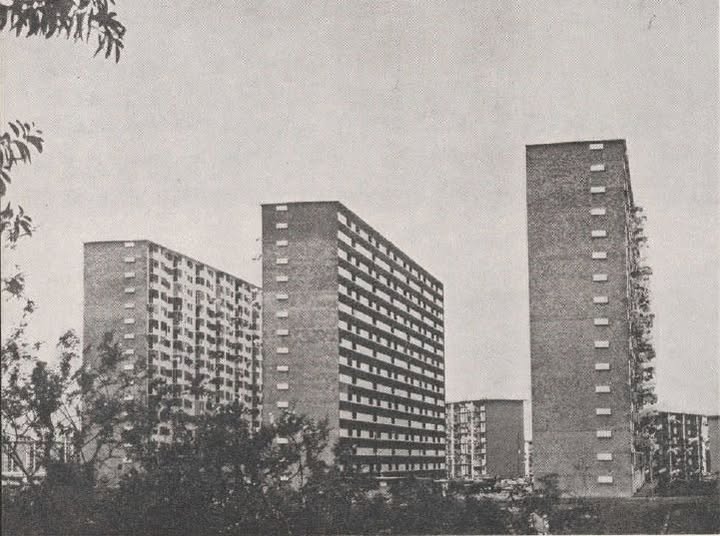
Little memories 42: 1965, Commonwealth Close 16 storey blocks in Queenstown. I bought a two bedroom flat for $6200. Mine was the center block facing the opposite block. It was very noisy. All the TVs were on full volume. There was loud chatter too. CNY was incredible. There was competition to see who could string longer fire crackers. Imagine the echo between the two blocks. The noise was magnified. The entire feeling was like a war zone with heavy smoke and continuous blasts. The entire ground was covered in red. People threw crackers across for fun. Those were the days where wild spirit gave vent uninhibited…

Little memories 43: many years ago a dog, escaping dog shooters ran into my house to take shelter. He stood proudly at my gate watching the shooters walk by. He was so smart and gutsy. I took an instant liking to him and adopted him. I called him Sparky. It was actually he who adopted us!
Years later when I was scout camp commissioner at Sarimbun there was another dog event. There, a stray that had adopted Sarimbun camp as his own adopted me. When ever I was there he would follow me. We naturally bonded so I took him home. We had a malay house keeper who did not like having him around so I took him to my office where he was quite at home.
We were working late… he took his leash in his mouth to me saying he wanted to go home. I said can’t at which he turned and ran downstairs. Someone had left the door open and he ran out. We searched everywhere, could not find him.
At 9pm I got a call from SPCA that they had him. I had written my mobile number on his collar. He was hit by a car. I went to SPCA and picked him up. His body was still warm. With tears we buried him in the forest clearing beside the house… dogs are not animals, they have personality, can read us. They used to be bred as fierce guard dogs. The fiercer the better.
That is why so many Singaporeans are afraid of dogs. Dogs are different now. They are part of family…we put a Scout scarf on him!

Little memories 44: 1974, I had moved my practice to Malaysia. My practice in Singapore came to an end due to political pressure but.thats another story.
I was in Kedah, went to a village, saw a “Katek Ayam”, a miniature chicken, a bentam. It was so cute. I decided to buy a pair and bring them home to Singapore. How to? I got a vet to inject them with a tranquiliser so they would sleep while in the plane. That worked till we nearly landed and they began to cluck softly. Luckily they remained relaxed till we landed and cleared immigration. When I set them free in my garden they took to it with delight and roamed freely till feeding time. They always came back at feeding time. They were a charming addition to my life. They began to roam further and further away into the surrounding forest till one day they disappeared all together. In a way I was happy for them…
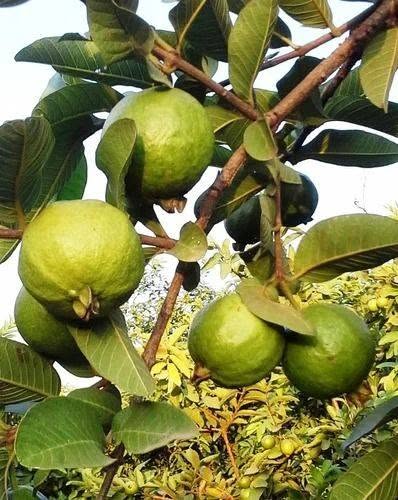
Little memories 45: Pak Kia or Guava was our favourite kampong fruit. The trees are not tall. The wood strong. We could climb up to the top where the fruit were. Hard, full of seeds but the taste was wonderful. The ripe fruit was heavenly. Later we discovered ones with pink flesh. These were even better. Then came the large imported ones… tasteless!
The guava trees had thick branches to make “lastic” because the wood was strong to take the bicycle inner tube cut into straps to make sling-shots.
A childhood wandering around kampongs taught us many things. Alas there are no more kampongs.

Little memories 46: 1973, disgusted with practice after my partners were told to expell me, I decided to be a photo journalist so I went to study and document the Muda River rice cultivation project in Kedah.
I learned how the chinese merchants by-passed the govt’s price controls, how the rice mills operated, how fertilisers were distributed. How was the distribution of work between men and women and how cultural activities took place during the rice growing period. Later i saw how owls were used to control mice pests.
Years later, on reflection is saw how wrong ” the lazy native” was. The malay peasant could and would work very hard when work had to be done. But in the office season, it was time to relax and do cultural work

Little memories 47: August 17, Indonesia’s national day is celebrated by a kolek and jong sailing festival in Blakang Padang an island next to Batam. There is a similar jong festival in Johor.
The kolek races are by class. The number of crew defines the class. Low on the waterline the koleks are always in danger of flooding so there is one crew member bailing all the time. For speed, the sails are enormous. The mainsail is stretched upwards by a tall bamboo sprit, the foresail, the jib is stretched forward to the front bow.
To prevent capsize, the crew hang out on trapezes linked to the main mast. Everything about the boats are homemade. Each crew is like a family of neighbours who spend all their free time keeping their kolek and its sails in good order year round in preparation for the great race on 27th August..
We used to have jong races in bedok and mata ikan in the 60s but alas, de-kampongnization ended it all

Little memories 48: 1965, SPUR public exhibition on Singapore’s environment past, present and future under the Patronage of PM Lee Kuan Yew. The exhibition was in the open space next to the WW1 Cenotaph. The govt was very annoyed by two pictures I put of a chicken coup next to HDB flat. Early next morning I brought a can of white paint to block out the chicken coup picture.
It was my early political learning experience..

Little memories 49: 1970, I was teaching part time at Singapore University Architecture school at Ladyhill campus. To teach radical functional design i asked the students in my class to make a design so a fresh chicken egg will not break thrown from the second floor. Recently I met a student from that period who remembered that exercise so many years ago. It was hilarious. Most of the eggs broke. Only a few did not. Mine did not based on the principle of uniform all round pressure. I surrounded my egg with a discussion jelly and enclosed it in a box taped all over. The parachute types survived. The winged types failed because the wings were too small.
Nowadays designs tend to be expressions of imagination…function has become secondary…

Little memories 50: 1980s Potong Pasir. Me and my students spent one week studying Potong Pasir village from dawn to dusk. Yes, it was a multi racial community. Neighbours shared gossip, salt and sugar. Their kids played together. There was peace. They sheltered gangsters from police. In exchange they got protection. Yes the houses were clustered together serviced by narrow alleyways. Fire was a concern so neighbours formed fire protection protocols.
Sadly, all the maps and photos have been lost.

Little memories 51: 1950s camping in Pasir Ris beach front coconut plantation. See how well the canvas of the tents were taut. I had learnt early the flow of forces across a surface from making my bed, how to stretch the sheets. This sense also manifested in my architecture, the glow of energy through spaces and surfaces that made for a sense of spatial order.
Camping was a total learning experience. We caught blue crabs as the tide came in. I climbed coconut trees to pluck the just enough ripe ones to drink and eat the jelly-like flesh. Swaying at the top I tied myself to a hammock and even took a short nap.
Camping there in December we saw cloud clumps parading across the darkening sky followed by thunder and intense rain. There is no such thing as a shelter to be able to lie down dry and see the rain water dripping onto the sandy soil all around. On clear days, we see smoke rise followed by loud explosion coming from the granite quarry on Pulau Ubin across the sea from us. Much later i learnt the Ubin is Malay for granite!
Camping like this is a great learning experience no book can teach…

Little memories 52: 1948 as a 7 year old ACS Wolf Cub just moved to Braddell Heights. The Wolf Cub call every Wednesday after school at ACS primary school at Coleman street was, ” akela, we promise to do our best.” And we always tried…
The ground was red earth. There was no hedge around the house. It was hot and dusty. Me and my brother collected trailing grass shoots from the grassy banks of the roadside drains and scattered them on the dry ground. We sprayed water in them in within a short while they took root and soon the land became green.
A contractor was engaged by my father to start the hedges around the house. They dug a shallow trench around the perimeter, filled it with black earth and stuck in row upon row of short criss-crossed string bush sticks and watered then everyday for a month. Soon they sprouted and within 6 months we had a green hedge fence around the house.
Soon the exploration began of the neighbour-hood. Crept through lullaby of tunnels made by the pigs of the neighboring farm. Found tapioca, took them, roasted and ate them. There was a bamboo clump. This supplied the means to make bows and arrows. Wandering barefooted clad in shorts and singlets our skins became very black. Soon i started a small group of neighbors, ” The Braddell Heights Boys Club”, no girls are allowed! Penny the sister of Billy Tongs wanted very much to join our club…

Little memories 53: 1990s, someone drew this cartoon and sent it to me through the then NUS architecture head of department Milton Tan.

Little memories 54: 2000s fishing trips up into the upper reaches of the Endau-Romping with our Orang Asli guides was delightful. Clear waters, rapids, overarching tree canopies over the river. Gigantic granite boulders shaped by water flow over millions of years. Bird calls and sharp cicada announcements of day’s end are an everyday thing. The floor of the primary forest is not cluttered by shrubs but is open. Occasionally the Asli point out clumps of durian seed and remark that the scattered ones are by bear whereas the piled up ones are by tiger. I don’t fish. I watch my friends do it. Mostly they catch the common sebarau but the prize fish is the kelah or golden maseer rarely caught. We roasted them over fire ambers. Very tasty! One night, the gas of the light ran out. There was total darkness and then there was strong urine smell. It was terrifying, there were 8 of us. We all slept under one huge tarpaulin. I was on the outside edge. A tiger was circling us! Luckily, after a while, it moved away. I added this last bit because memories are intermittent: they come unannounced.
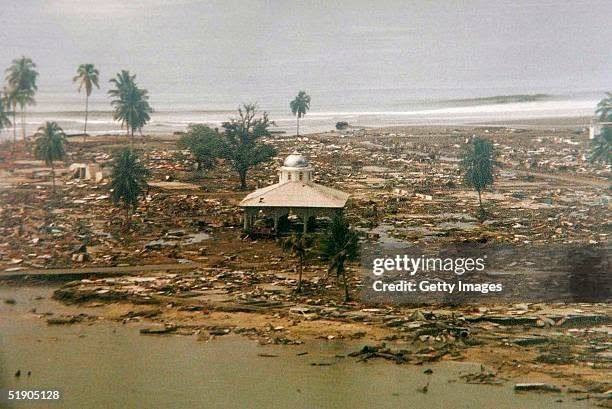
Little memories 55: 2005, I am in Meulaboh at the request of Zul Baharudin, then chairman of Mercy Relief to help. I agreed instantly. The tsunami devastation was terrific! To see it in person trumps all description. What is astounding is the buoyancy of the human spirit of the locals. We rebuilt several schools. My favorite project was an Islamic kindergarten totally demolished by waves from the nearby beach. I deliberately made a playful design with holes in walls so kids can peep out. Made irregular doors and windows painted in many different colors. When completed the teachers and kids loved it.
I proposed a bamboo belt along the coast. Fast growing bamboo will cushion the waves. The big project was the upgrading of the general hospital. It was a signature project and thus several foreign agencies wanted it. I forcefully convinced our foreign ministry that this must be Singapore’s signature project. This was finally agreed to. By that time, Mercy Relief management changed hands and I was no longer in the picture. At the opening ceremony I was not even invited. I thought to myself so be it…

Little memories 56: 2005 in Aceh with Zul Baharudin, another Mercy Relief activist Hassan Ahmad and Indonesian officials. Because of Singapore’s rapid relief response, Indonesian officials are very grateful. One official said to me that we can have anything we want. Natural resources and joint ventures. This was an eye opener that we can do well by doing good in the region.

Little memories 57: 1990s, Went to the head waters between the Muar and Pahang rivers called the Penarikan to see if possible to do a trans- peninsular trip from west to east. Penarikan means to pull. ie in malay, to tarik, ie to pull a boat across from one river to another.
It was a trip Hang Tuah did to escape the Portuguese. He went up the Muar river to Serting then pulled (tarik) his boat across a 300m flat land bridge to Sungei Bera a tributary of the Pahang river and from there downstream to Pekan, the capital city of Pahang.
I walked across to the Bera river and found it to be totally clogged with timber debris. The locals confirmed that lots of clear cutting waste were dumped in the river from oil palm estates alongside. So too bad had to abandon the idea.

Little memories 58: 1975, with Datok Bandar, mayor of KL visiting Cheras my high density, low-rise, low- cost cluster-linked housing that i critiqued HDB about and roused their ire. The great irony of the KL Mayor’s visit was to host the Singapore’s HDB visit to my project! It was truly embracing for me, a Singaporean representing KL!
Cheras stirred great interest among KL’s surrounding squatters who loathed the idea of being resettled in high-rise flats. Lat drew a cartoon showing a ‘bayee’ telling a taxi driver to send him to the back of the queue surrounding city hall applying for a house in Cheras.
It happened like this…
On my way back from my photo journalism project to document the Kedah Muda River rice project, I stopped by KL to visit Low Keng Huat my friend who built Peoples Park Complex. The universe had plans… my visit coincided with the end if a year-long project by the developer’s association charged by PM Tun Razak to build flats at RM5000 per unit.. they could only bring it down to RM8000.
I showed Keng Huat my design of two-storey cluster-linked houses, each with a small front garden. He took a look at it and did quick calculation and said to Datok Tan Chin Nam the then chairman of the developers association that he could and suddenly theory became reality overnight!
I stayed on in KL and built over 10,000 units of various kinds of low cost housing. This restarted my architecture career and created many new future adventures…

Little memories 59: 1965, I proposed through SPUR, Singapore Planning and Urban Research the idea of “long island.” 60 years ago. The idea then was to create a freshwater reservoir formed by the island and the mainland. Sea level rise was not in consciousness then.

Little memories 60: 2009, because of my involvement in the Aceh Tsunami relief work Lien Foundation introduced me to Mechai’s school project in Buriram Province in Thailand. My first project was a rammed earth and bamboo building to house various facilities for village uplifting. This led to Mechai’s secondary school next door to turn the poorest children into Thailand’s smartest.
The school was radical in design and radical in education. I designed the school like a kampong. Mechai designed the learning culture. The two matched each other perfectly. No exams. Student learn by doing projects that helped their family finances. MOE insisted they take the standard Thai exam yet the came out in the top 5 percent of Thailand!
Students come to school in the weekends to do their own projects.
School to them is their second home!

Little memories 61: 1968, I am in the waiting seat outside PM Lee Kuan Yew’s office in City hall. I was told to wait there by his secretary Sankaran. He said that Mr Lee will appreciate it if i not smoke. A little later Sankaran came back and saw a cigarette butt in the ashtray on the small table in front of me. I did not smoke, it was not mine. He said angrily, “I thought i told you not to smoke!” That irritated me so I said to him, “If you do not clear your ashtray don’t blame me!” He left in a huff… soon afterwards, the door opened and I went in to see the great man..

Little memories 62: 1969, on UFOs, I and a friend were seated on the deck of my catamaran anchored just off Coney Island at Ponggol. It was a moonless night. The sea was like a flat sheet, windless… we saw a white light far in the distant eastern end of Pulau Ubin opposite us. The light moved fast at a steady pace, reached the western tip of Ubin opposite us. It was totally silent, proceeded westward and suddenly shot vertically up and disappeared. It was shocking. We waited for waves that might have been created but there was none. What was it???
Drones then was unknown. Was it a UFO? Till today i am puzzled.
Earlier in the early 60s there was talk of UFOs in Singapore. We pranksters did a trick. We stood in the big car park in front of the Fullerton Post office and pointed to the sky above just to see the effect. All traffic came to an end. Crowds followed our skyward gaze. Everyone was looking for UFOs. Giggling, we snuck away.

Little memories 63:
Kampong Peta, a Jakun Asli settlement with asli friends Chimi and Kamal and two Singapore fishing friends Peter and Simon. Peta is an orang asli resettlement village located in the upper reaches of the Endau river close to the Johor/Pahang border.

Little memories 64: 1986, Minister Dhanabalan took over MND after Teh Cheang Wan’s death by suicide as an “oriental gentleman” so as not to have to implicate others.
When Mr Dhanabalan heard of how PWD usurped my KK Hospital project appointment when the site was changed, he was outraged. He promised to do something about it. He got me back the design part but the project management part remained with PWD due to their resentment against me. This is an example of the complex dynamics between insiders and outsiders, according to how dark is their political color.
There are the whites, the greys and the blacks.

Little memories 65: 1966, I spent a year going round the world to round up my architecture education. Here I am at San Jose visiting the Salk Institute designed by Louis Kahn.

Little memories 66: 1966, I was in Chicago in december in minus 20 below zero trudging through snow and ice to visit Frank Lloyd Wright’s houses in Oak Park. I approached Robbie House, knocked on the door, the owner opened the door, I tried to speak but my jaw was frozen, she pulled me in by the collar, brought me to the kitchen and gave me hot tea. Wow, that was American hospitality!
The kitchen was wonderful. It was very long and narrow with a study at one end!
After i left, as i trudged along ro the railway station, a car pulled up and told me to get in. It was a middle aged lady. She chimed me for walking in such weather, took me home for dinner. It turned out she worked with Wright before. When I said that I had written to the Wright’s office but got no response, she immediately call Wright’s daughter who confirmed that i visit Taliesin in Arizona. This was yet another of my experience of American kindness all in one day!

Little memories 67: Taliesin Arizona, Frank Lloyd Wright’s winter studio in sunny Scottsdale. Here i am in Taliesin West, given a small cozy room next to the pool. There, I met Mr. Ming, Wright’s Chinese draftsman who worked on the Imperial Hotel in Tokyo and who brought Wright to Shanghai where Wright learned about Chinese Art and acquired many Chinese porcelain sculptures which he embedded on the garden walls of Taliesin Arizona.
I helped Ming do his vegetable garden with strange american tools. When I came back to Singapore, I sent him a proper changkul.
I had a strange encounter with Mrs Wright, Olgivana. I had wandered into the western side of the estate admiring the desert landscape. A lady dressed in black wearing a huge black hat in a wheelchair flanked by two black dogs approached me demanding why I was intruding in Wright’s private area. I apologised and retreated…it was scary…
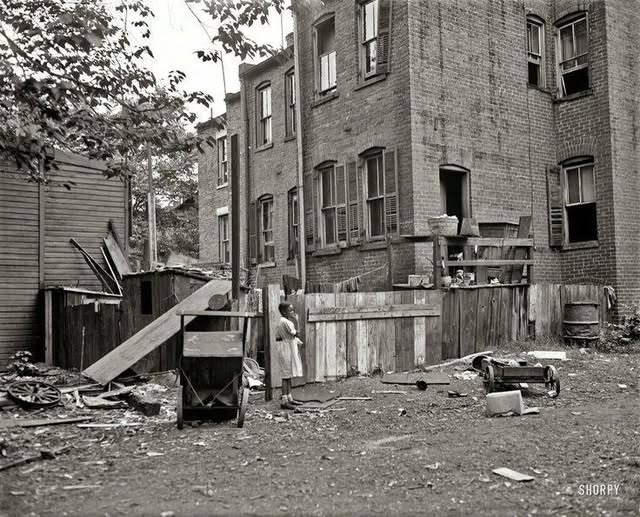
Little memories 67: Chicago slums. I visit slums in every city. The Chicago slums are particularly depressing. It is not just physical poverty. It is spiritual poverty turning into depravity. I saw broken windows in terribly cold winter. A bicycle was suddenly thrown down from above. In New York’ West Side i experienced a bottle thrown down in front of me. It was scary.
Asian slums are different. Poor yes, deprived yes. But still trying. Making do. Why the difference? This question remains with me for a long time…
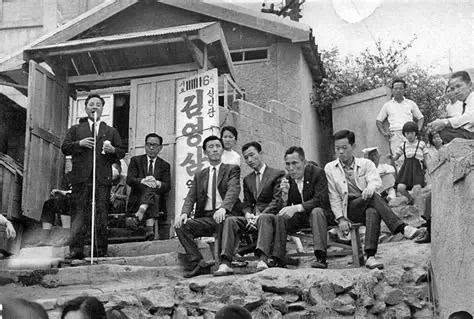
Little memories 68: Seoul 1967. Was on my way back east from the West. Seoul in 1967 was a big urban village of one and two storey huts with tin roofs. The kimchi was drying on the roofs. The smell of kimchi filled the air, but there was a sense of vibrancy too.
The Korean war ended a decade ago. South Korea was rapidly urbanising. I visited the boisterous inns. These were drinking places. The floors were covered with straw, loud singing, clinking of glasses, jostling, laughing everyone was having fun. All male, no women around.

Little memories 69: Shinjuku in early 1967 was an eye-opener after my Waikiki stop over, that was also an influence on my thinking later on coastal development.
Shinjuku taught me that shopping centres can be multi-storey with escalators. Once you have escalators, shops can be just as attractive on any floor. My design of Peoples Park Complex was indirectly inspired by Shinjuku though with only two up escalators but compensated by large atria for vertical visual spatial connection. William Lim’s association on this with Maki’s City Room Concept is only an elaboration. It was never my motivation.

Little memories 70 : my 1966 round world trip was on a very tight budget based on Arthur Fromer’s $5 a day budget. So i ate very little and stayed in YMCA hostels. The KLM ticket was the biggest cost item. As long as I moved forward it cost nothing. So i zigzag nothing south-wards. For example, from Israel I walked to Jordon and flew to Cairo and from Cairo to Istanbul then Athens and so on and on.

Little memories 71: 1966 photo of Central Delhi. When the plane’s door opened I was shocked by the blast of hot dry heat. I had never experienced anything like it. It must have been 42 degrees C.
The airport bus dropped me off at Delhi Centre. It was crowded with people and vehicles. I wanted to find my way to the YMCA hostel. I saw a well dressed man. He looked educated so I asked him for directions. His reply surprised me. He said, ” Sorry I am on leave!” and walked away. Haha my opening introduction to India! This was just the beginning…
I found a trishaw who took me to YMCA. Very clean and neat. I had a tiny room with a tiny cot. What a relief to have a shower! The coolness left very soon as the wetness evaporated. This was a lesson in evaporative cooling. Could not sleep so I drenched my bed sheet. That worked but soon did not. Have you ever poured water all over your bed? That’s what I did!
Next day i went back to the Centre. As I stood there, a shoe shine boy asked if I wanted my shoe polished. Without waiting he grabbed my shoe and ran off across the road and started polishing. I hobbled over on one foot. No choice. He grinned as he then took my other shoe and then I paid this cheeky boy who must be about 11 yo.
William Lim had introduced me to his old AA friends so I met them. Was invited to an Indian Institute of Architects meeting. It was in a park. They sat on the grass. Before the actual meeting they sang Vedic hymns!
India surprised me in so many ways!
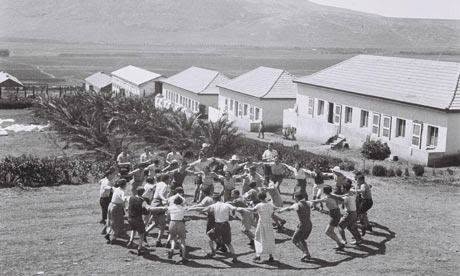
Little memories 73: 1966. The attached photo is of an early Israeli kibutz’s socialistic ideology. After Tehran I arrived in Israel. I meet another of Willy Lim’s AA architect friend. He was very kind, showed me many of his designs that use zigzag forms as the means of achieving curves and diagonals while sticking to rectilinear geometry. Another thing I learnt from him was the power of light from the sky even through a small opening. This knowledge i applied later in the Sim Kern Teck house in Frankel Street.
After visiting the usual places in Jerusalem I decided to go north to Caesarea and chanced on Kibutz Sot Yam where I was allowed to stay a few nights. There i experienced the communitarian spirit of early kibutz life.
To get to Cairo was my next plan. To do so, I had to cross over to Jordan, I had to get a certificate that I was not a jew. To do this I had to meet a Christian pastor who certified me. With this paper I took my luggage and walked across the border to Jordan. It was dramatic. The Israel side was all green, the Jordan side was all brown. I guessed it was deliberately done so. Israeli strategic thinking. i was totally innocent in thinking then..

Little memories 77: 1968 Spear fishing off Pulau Yu off Johor’s East coast. I developed my spatial senses a lot through spear fishing. I could put together the tide, it’s heading, water temperature, coral formation and where the current splits. Then there was the anticipatory sense where the big fish might be. I was always the one who hit the right spot at the right time.

Little memories 78: 2004 My new type HDB neighbourhood housing design hated by HDB senior architects. Under the design and build scheme my design was shortlisted. The PS MND at that time called a special meeting with me and the senior HDB architect in charge to hear out his objections to my design which was different:
- Cars are parked in a continuous semi basement beneath the housing blocks. Not normal.
- The blocks were linked to form a ring around the site. Not normal.
- The blocks were all of different heights. Not normal.
- The community green is in the middle. Not normal.
- The entrance to each flat is from front corridor next to kitchen. Not normal.
- The living room at the back of the flat faces the green. Not normal.
- There are 15 different flat types of different sizes. Not normal.
- Benches at intervals along the corridor. Not normal.
- Recesses along corridor for shoes and religious objects so they don’t protrude. Not normal.
After hearing these objections the PS boldly said, “Let him try!” And so it got built!
After it was built, the HDB took revenge. They did not maintain the place and I was shocked how it deteriorated. However when I revisited in 2021 it was well kept. I met several second-hand house owners who were delighted with the place.
Little memories 79: 1960s to 70s we were diving in Singapore’s southern islands. Water clarity was an issue. Every year they published the Singapore tide tables. Water was clearest when there a several days when the tidal difference between low and high was minimal. This means the sea currents would be slowest which means dust particles would settle and water would be very transparent.
On one such day I was diving off Pulau Bukum, I could see the sea bed 20 meters down and I spotted a huge guitar shark gliding along near the sea bed.
Pulau Hantu has the most prolific coral assembled. I wondered why. I have dived in many places in Malaysia, Puked, the Mediterrean, Mauritius, Australia, there is nothing to compare with the richness of our coral reefs, the variety if coral types, polyphs, ferns, etc.
I think it is because of shipping. Ships carry loads of plankton and other tiny oceanic organisms. They drop them off when in Singapore waters.
Alas we are losing our reefs to development. A part of our rich natural heritage heritage is being lost…

Little memories 80: 2005, my design office with curvy form desks…

Little memories 81: this picture suddenly popped up in my computer photo file! It is part of a series of aerial photos i took with Robert Gamer in 1964 as we flew over Singapore. This one is of Koh Sek Lim sand pond in Bedok. i later dived in it. The water was crystal clear. Could see down 20 meters to the bottom. The sides are almost vertical. Surprising for a sand pond. Yes I saw a few large fresh water fish. What’s happened to it??

Little memories 82: 2024, my curvy desks have found their permanent place in my home where I ruminate…

Little memories 84: Kampong Temasek on 10 acres of land owned by Jack Sim loaned to Kg Temasek for 10 years at $1 per year. It gave a kampong experience for children and adults until it was closed down due to MOE fears. I held many tree-house building camps there for architecture students.

Little memories 85: 1958, my design of a house as a 17 year old apprentice in Ang Kheng Leng’s office that has survived till today!

Little memories 86: 1966. Visited my brother in Bristol. Had to visit this famous bridge.

Little memories 87: 1986 ITE BISHAN. Sadly now demolished, was an example of an intelligence awakening interactive campus where people see and mix together unlike the usual beehive-like blocks upon block designs.

Little memories 88: Circa 1970s, my study of alternative design for Toa Payoh neighborhood’s 10 storey block design replaced by 4 storey link-blocks with football size open spaces within. This changed my professional life as much as my political activism.

Little memories 89: 2005, Autonomous House NUS Design Studio. I was fortunate to have a bunch of extrordinary students who were full of initiative. Many of them are today leading members of the architecture community and other professions.
This project was to design and build a shipping container size dwelling for two people, generating its own electricity, collecting its own rain water, filter and recycle it, compost its own waste, fertilize its green roof etc, etc.
The students managed to get a donation from a large developer on their own, bought their own materials and designed and built the house in 3 months.
This photo shows the HOD and the Visiting PS MOE! I am so proud of this lot of students. LHL’s daughter was part of the team…

Little memories 90: 1987, Chee Tong Temple was built. My visiting guest wanted to visit it. Confused by the route description the taxi driver suddenly blurted out, “Oh I know! It’s the temple of the glass lotus!”
I never wanted to do a fake Chinese temple in Singapore that has no traditional Chinese crafts people left. To do so would be totally faking and I did not want to do that.
An unusual thing was also there. The temple committee said my design had to be approved by the deity which I found to my astonishment was a lady medium in a trance. So she asked me in a gruff voice and I answered as best I could. Eventually she looked at my design and approved it as it was so unusual, the committee simply accepted it too.
There was one major crisis moment regarding the sharp corner of the 4 corners of the roof. She said it was not right that they should point at neighbours. Gosh! Does that mean i had to tilt them up in the traditional manner?
My solution was to chop the corners off by making the roof octagonal. That was approved and so it stands as the “glass lotus.”
The glass roof top was both a sun shade but also a reflector of the temple’s altar lights.

Little memories 91: 1995, KK Women and Childrens’ hospital completed at last!
I had the pleasure to launch LINE EDGE AND SHADE a book on my firm’s work, a book edited by Robert Powell in the hospital which had been made hostile territory for me as declared by the PWD but NOW DEFUNCT project managers.
it was thus with a sense of relief for me that the Hospital I designed now served double purpose as a free space and the place to launch my book..


Little memories 92: 2024, my big book edited by Dr Kevin Tan from my collected writings of one and the half million words down to one million. He titled it, “Big Thinking on a small Island.” I was happy that many of my students bought a copy. It covers many things. There is even some correspondence between Lee Kuan Yew and me.

Little memories 93: 2013, the final phase of the Rubanisation concept is the one kilometer square Modular City of 100,000 population. It is conceived as an integrated living, learning, farming, healing and making place.
One year later in 2014, TKS presented his vision of a deployable modular city. This is now available on YouTube

Little memories 94: 2009, The formal contract signing of my appointment for Hue’s Tourism Masterplan as part of the Singapore-Vietnam connectivity agreement. It was signed at the Istana in the presence of both Heads of State.
I had proposed a crafted conference centre in Bavi, the legendary location of the founding of the Vietnamese people. As part of the proposal, I had added a craft village to gather together the remnants of craft people in the surrounding villages to build the convention centre. Which then intersected the scheme to then Minister for Culture and Tourism. He was emotionally moved when he saw my design based on the availability of real crafts people. He thanked me for saving the crafts people from their eventual fate of becoming factory workers. He then asked me to do the Hue Masterplan as Hue is Vietnam’s cultural center.

Little memories 95: This picture was taken in Batam of Asian Dialogue Society’s Academic members (ADS) brought together to discuss, at the request of the then Mayor of Batam, the idea of an ASEAN University there. This ideas has since morphed into the concept of a NEW ASIA UNIVERSITY, NAU.

Little memories 96: August 2026, I had the pleasure to chat with George Yeo, Singapore’s former Minister for Foreign Affairs, and now globally the face and voice of new Asia. Typical of my accused bluntness, I said to him I can think of no better person that can bridge Singapore’ Present to its Future but him. I felt that there was somehow, a connection.

Little memories 97: 2026, Many things have come together. First was SPUR, then i was invited to join ADS, Asian Dialogue Society because they were interested in my ideas on rural urbanisation ie Rubanisation. Then FOSG, Future of Singapore group was formed in 2017 to share ideas through public discussions. Then in 2023 FC, Friday conversations was formed to hold public discussions in Palm’s Cafe at Tanjong Pagar. Finally everything coalesce into FOSSEA, Future of Singapore and Southeast Asia and George Yeo agreed to meet and chat with us. We had a wonderful exchange.

Little memories 98: 2024, I finally put together my ideas about the kind of Singapore can be in a simple way, a book with many pictures with big short texts. President Tharman invited me to the Istana where I gave him a book. He read it quickly and asked for another. The question mark on the cover is not about Singapore’s Future but about what kind… Thank you, Mr. President for hosting me..

Little memories 99: 2020, as a Southeast Asian, I felt compelled to contribute to Indonesia’s Nusantara City project in Kalimantan. When i looked at the design schemes submitted mostly by younger architects I was struck, few had taken up the Pancasila theme. Pancasila was the conceptual and ideological basis of Indonesian unity from its inception yet it was absent. And so i made a design of the administration’s central building consisting of five towers crowned by a circular ring of the Presidential offices with the mighty Garuda Crest.. my friend, Singapore’s former Ambassador Edward Lee then forwarded it to the Indonesian Minister in Charge and promptly received a warm reply in response. It was indeed gratifying that I could do something for our friendly neighbor.

Little memories 100: 2010. After 2 rejected recommendations, i was finally given SIA’s highest award, it’s 5th gold medal. It is customary that former Gold Medalist serve on future adjudication committees.
That was when i suggested a 5 point judgement system. 20% for personal design excellence, 20% for building a strong design support team, 20% for participation in education, 20% for helping the profession and finally 20% for strong public standing. This helped remove political bias.
My life has been a whole series of challenges and in retrospect, I am grateful for them because they energised me and revealed who were my real friends. Architecture is for me; always the melding of complex and seemingly contradictory factors. The process of reasoning, sensing and moral judgement involved is life itself. Aesthetics is simply the grammar in the synthesizing of form and the ordering of thought… Beauty is but a social construct. Aesthetics is the grammar of life itself.

Leave a Reply